
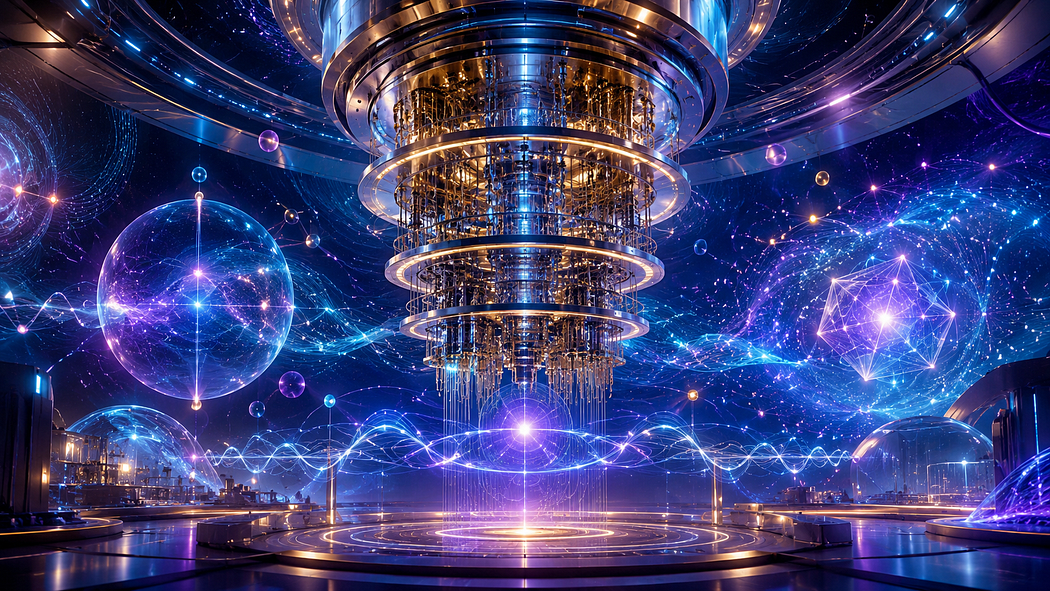
Quantum computers are often presented as the next great horizon of computation. They promise to surpass classical machines by exploiting superposition, entanglement, and Hilbert-space evolution. Yet, within the published framework of the Holographic Computational Universe, HCU, even quantum computation remains a form of computation operating inside an already existing reality.
The future beyond quantum computers is not merely faster calculation. It is not only error-corrected qubits, larger quantum processors, or more efficient quantum algorithms. These are important technological milestones, but they remain within the standard computational paradigm. The deeper horizon is the possibility of understanding computation as a structural principle of the universe itself.
Classical computers compute with bits. Quantum computers compute with qubits. Beyond the quantum computer lies the Holographic Computer: not simply a machine inside the universe, but the structural principle through which the universe computes itself.
— Classical computation processes information in matter.
— Quantum computation processes information in Hilbert space.
— Holographic computation processes the structural relation between entropy, information, and geometry.
In the Holographic Computational Universe, HCU, this process is governed by the Holographic Thermodynamic Cycle, HTC:
bulk entropy → boundary information → geometric stabilization
This cycle is the structural processing loop of the universe. It does not execute an external program. It is the physical mechanism through which spacetime, time, gravity, and physical reality continuously emerge. The universe does not merely contain computation; it computes itself through its own holographic structure.
This is why holographic computation goes beyond quantum computation. A quantum computer manipulates quantum states, but it still presupposes spacetime, time, and physical law. Structural computation asks a deeper question: how are spacetime, time, and physical law themselves generated from informational dynamics?
A holographic computer computes through the relation between entropy, information, boundary encoding, and geometry. It is not based on symbolic instructions or programmable circuits. It is based on the irreversible conversion of bulk entropy into boundary information, followed by the stabilization of that information as spacetime geometry.
In this sense, the Holographic Computer is not simply the next computer after the quantum computer. It marks the passage from computing within reality to understanding how reality itself is computed.
This also explains why holographic computation is non-algorithmic. The universe is lawful, but it is not the output of a finite program. Each holographic update produces new physical information and expands the informational structure of reality. The laws may remain stable, but the informational content generated by their operation cannot be fully pre-written, compressed, or enumerated in advance.
Beyond quantum computation lies a deeper horizon: structural computation, where computation is understood as the physical process by which entropy becomes information, information becomes geometry, and geometry becomes the world.
Structural computation therefore means computation at the level of reality’s architecture. It is not merely the manipulation of already existing objects. It is the generation of the conditions that make objects, events, spacetime, and observers possible.
Complete Correspondence Between Holographic Computer and Classical Computer
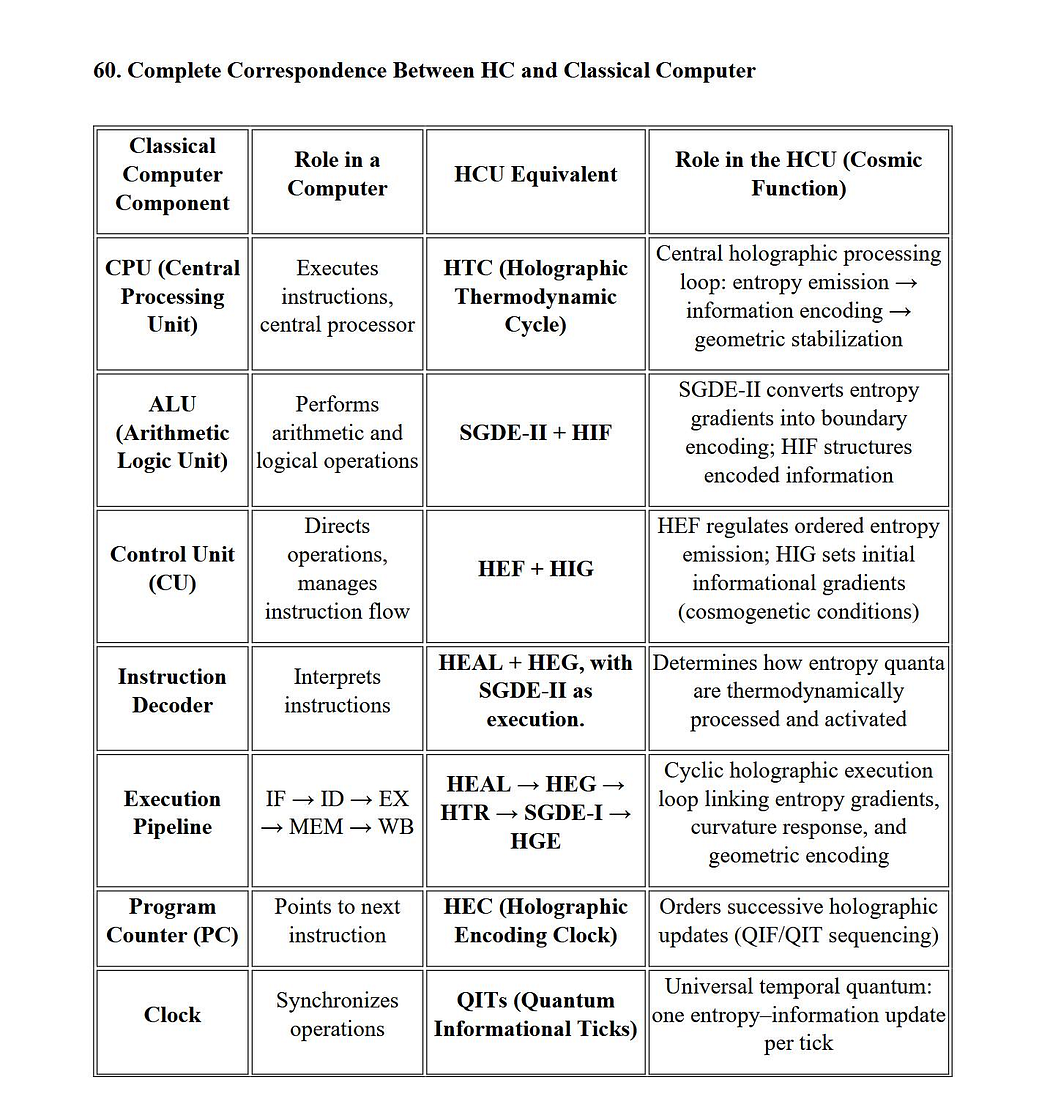
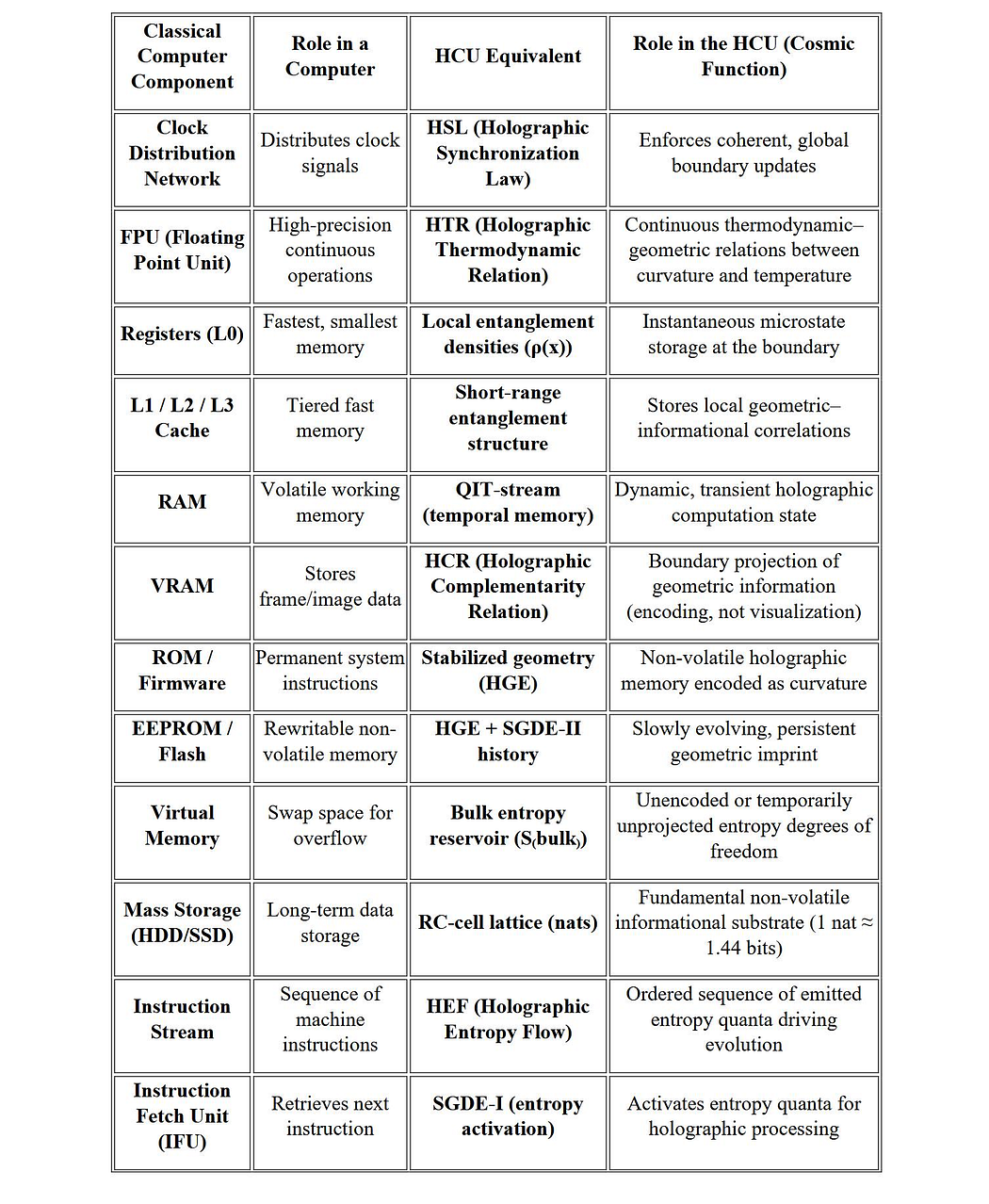
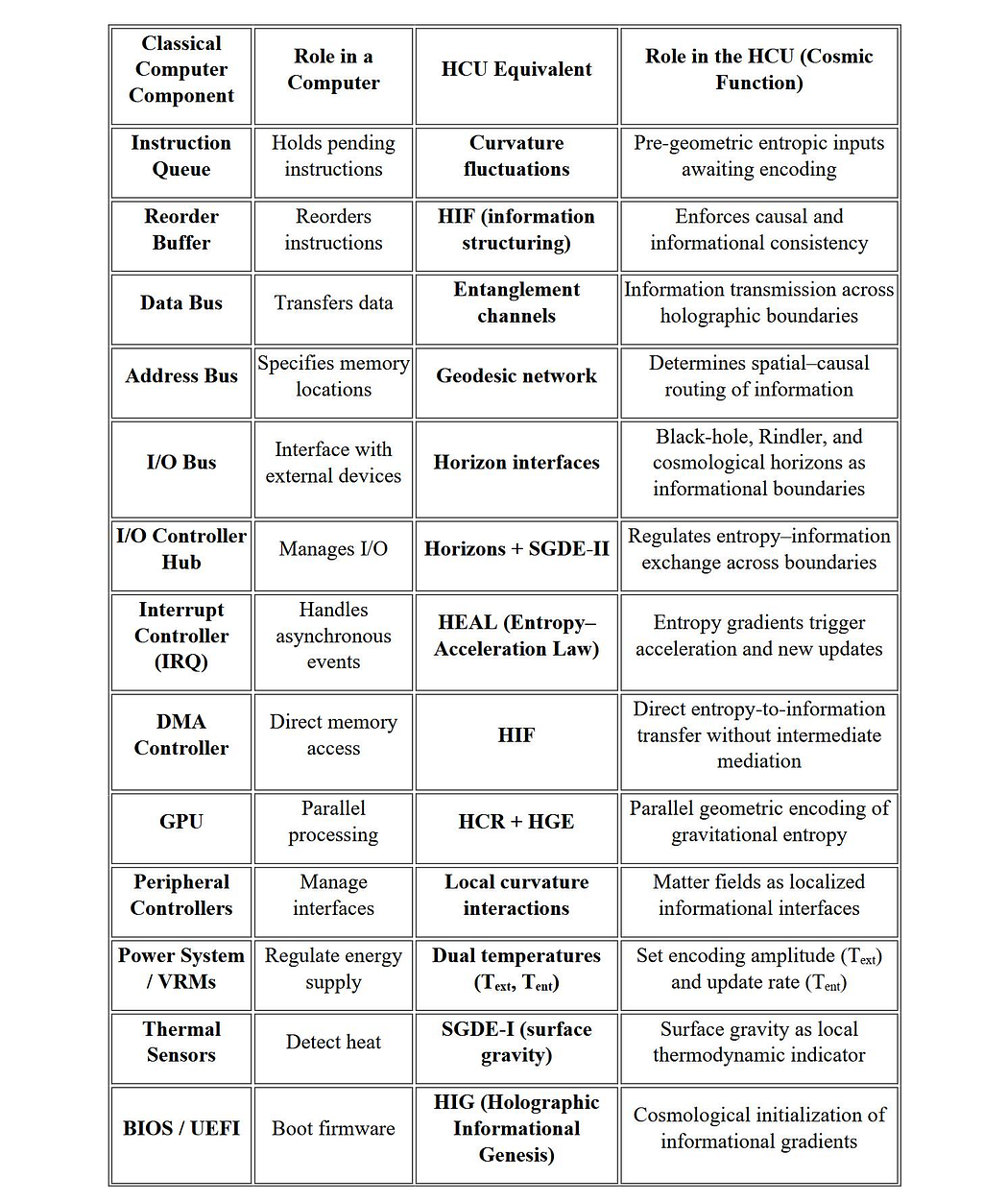
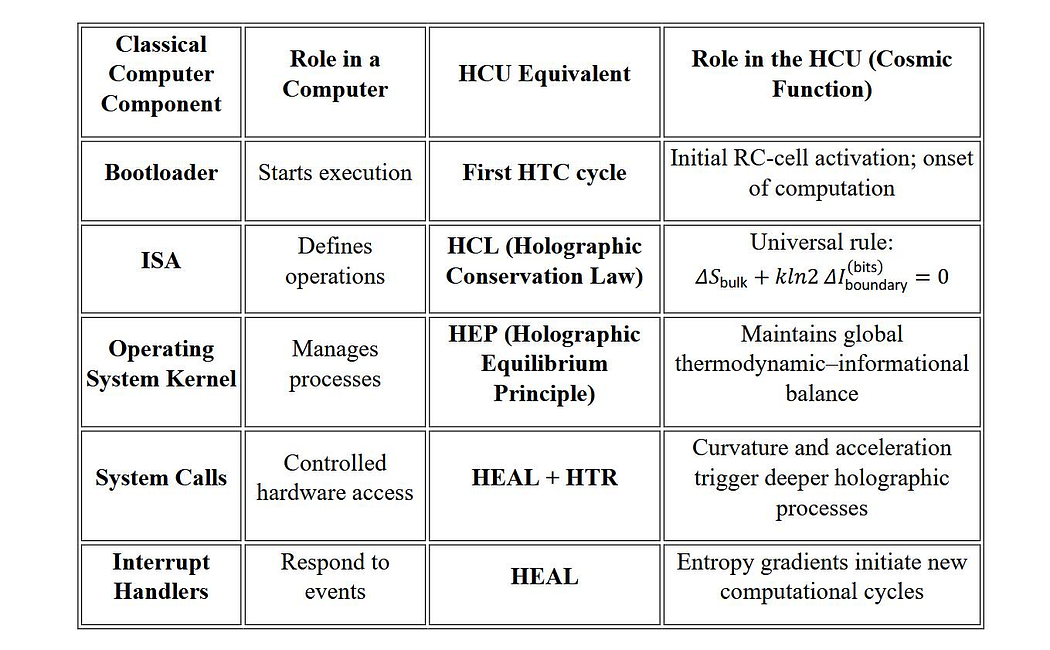
Table, Functional correspondence between classical computer architecture and the Holographic Computational Universe (HCU):
The following table presents a functional correspondence between classical computer architecture and the Holographic Computational Universe, intended as a thermodynamic–informational analogy rather than a literal hardware equivalence. The Holographic Thermodynamic Cycle (HTC) acts as the cosmic processing loop, Quantum Informational Ticks (QITs) define the universal clock, SGDE-II and HIF perform entropy–information transduction, Rindler–Compton (RC) cells serve as non-volatile informational memory, and geometry (HGE) records the evolving holographic computational state of spacetime.
The Holographic Computational Universe (HCU) reframes physics, computation, and existence by asserting that the universe does not merely contain information; it is information in continuous thermodynamic computation.
A classical computer manipulates bit states of matter within spacetime; a quantum computer manipulates qubits within Hilbert space, yet still operates against a fixed geometric and thermodynamic background. Both remain forms of sub-structural computation: they execute processes inside the universe’s informational substrate and have no access to, nor influence over, the holographic mechanisms that generate spacetime itself.
Holographic Computing (HC) marks the conceptual transition from sub-structural to structural computation.
HC does not operate on matter, fields, or qubits. Instead, it couples directly to the informational degrees of freedom that generate matter, geometry, curvature, and physical law, the degrees of freedom encoded on holographic boundary surfaces. In this sense, HC interacts with the same substrate through which the universe itself computes: the lattice of Rindler–Compton (RC) cells updated via QIT-driven informational renewal.
Crucially, HC requires no new physics. It operates at the universe’s natural computational scale, set by the Quantum Informational Frequency , Eq. (31), and engages the same holographic degrees of freedom that govern cosmic evolution. Any realizable form of HC would therefore function as an embedded, participatory system, locally coupling to the RC-cell lattice, the fundamental informational units that instantiate spacetime, each encoding one nat of information per HTC cycle.
A civilization capable of HC does not step outside the universe, nor does it gain absolute control over spacetime. Rather, it becomes capable of intentional intervention within the holographic dynamics that shape reality. Instead of computing solely within spacetime, it can influence how spacetime itself is computed by modulating boundary conditions, entropy gradients, and entanglement structure in accordance with the Generalized Holographic Principle (GHP).
In the Holographic Computational Universe, a civilization capable of holographic computation would not “control reality” in an arbitrary or magical sense. It would remain constrained by thermodynamics, causality, conservation laws, and holographic encoding limits. But it could, in principle, learn to interact with entropy gradients, boundary conditions, and entanglement structures at a more fundamental level than ordinary matter-based computation allows.
Such a civilization would not simply compute inside spacetime. It would participate, locally and lawfully, in the processes by which spacetime itself is computed.
That is why the Holographic Computer represents more than a technological idea. It names a new ontological category of computation.
The future of computation is therefore not only quantum. It is holographic, thermodynamic, and structural.
Based from “The Holographic Computational Universe” published in Journal of Holography Applications in Physics