
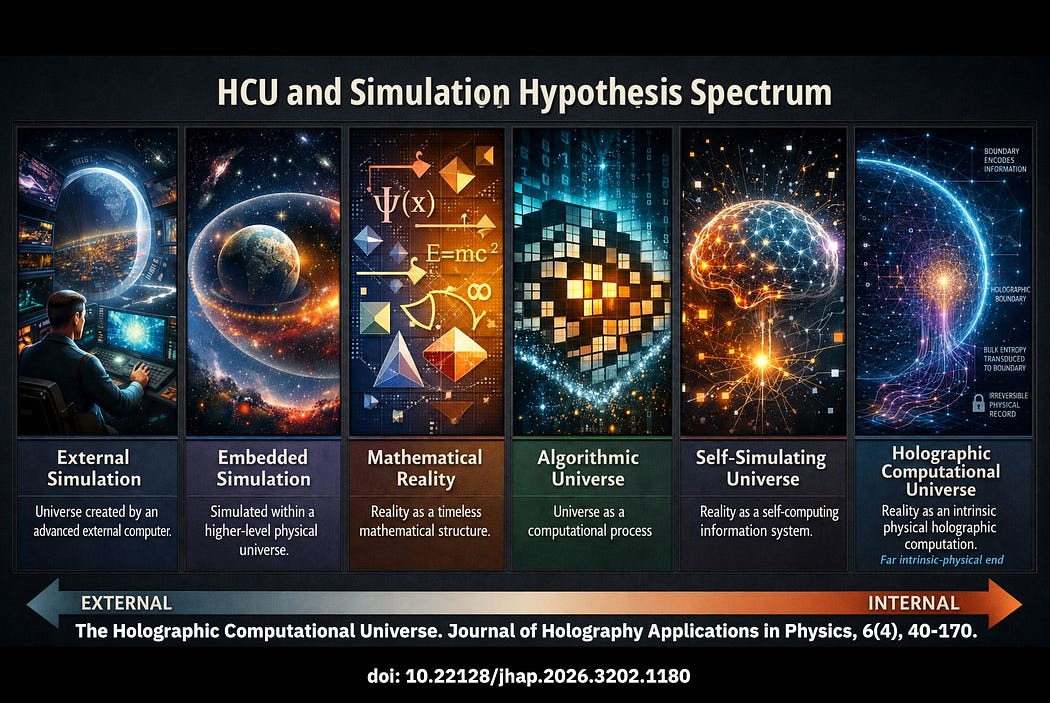
The term simulation hypothesis does not refer to a single claim but to a family of distinct positions. These differ in whether reality is generated by an external simulator, embedded within another physical system, identified with a mathematical structure, governed by algorithmic rules, or understood as an intrinsic process of information processing. Distinguishing these forms is essential, as they make fundamentally different assumptions about computation, simulation, time, entropy, irreversibility, and physical law.
A central nuance is that computation is not necessarily simulation. A simulation is a representation, imitation, or model of something else. It presupposes a reference reality, a simulated object, or a deeper system being represented. Computation, by contrast, can mean the physical transformation of information-bearing states. Therefore, saying that the universe is computational does not automatically mean that it is a simulated copy of a deeper reality.
Classical externalist simulation hypothesis. In its classical form, the simulation hypothesis asserts that our universe is generated by an external computational system operating in a higher-level “base reality.” Physical laws correspond to programmed rules, spacetime is a rendered state, and all physical processes are ontologically dependent on an external simulator. This version is most prominently associated with Nick Bostrom and is typically motivated by probabilistic arguments about technological maturity and ancestor simulations. Its defining feature is ontological externalism: the universe does not compute itself but is computed from outside.
Physicalist embedded simulation. The physicalist variant maintains the simulation idea while removing supernatural or abstract substrates. In this view, our universe is simulated by another physically real universe governed by similar laws of physics. Computation is still external, but the simulator is itself a physical system. While this avoids metaphysical dualism, it introduces an infinite regress problem and does not resolve the origin of time, entropy, or physical law, merely relocating them to a deeper level.
Mathematical or structural simulation. The mathematical or Platonic form claims that reality is fundamentally a mathematical structure, and that “simulation” is only a metaphor for instantiation. There is no execution, no computation in time, and no simulator; the universe exists timelessly as an abstract structure. This position is commonly associated with Max Tegmark. While it eliminates external simulators, it also removes any account of physical irreversibility, entropy production, or the arrow of time, treating dynamics as descriptive rather than generative.
Algorithmic universe hypothesis. The algorithmic universe view holds that the universe evolves according to local, well-defined computational rules, similar to a cellular automaton or rule-based dynamical system. Crucially, undecidability is accepted: although the evolution is locally computable, many global properties of the system are undecidable and cannot be predicted or certified from finite descriptions. In this framework, undecidability limits knowledge and prediction, not physical execution. No external oracle is required, but computation remains fundamentally rule-based.
Self-simulating or autological universe. In the self-simulating form, the universe does not run on an external computer; rather, physical reality itself constitutes the computational process. Information processing is intrinsic, laws are enacted rather than imposed, and there is no ontological hierarchy between simulator and simulated. Computation is physical, internal, and often irreversible, with spacetime and geometry emerging as persistent records of informational processes. This form rejects both external simulators and purely abstract instantiation, treating reality as a closed, self-consistent informational system.
Holographic Computational Universe perspective. Within this spectrum, the Holographic Computational Universe occupies the far intrinsic-physical end. HCU does not claim that the universe is simulated by an external computer, embedded in a deeper physical system, or instantiated as a timeless mathematical object. It also does not reduce the universe to a symbolic algorithm, a Turing machine, or a cellular automaton. Instead, HCU treats the universe as a self-contained physical holographic computational process.
In HCU, computation is intrinsic because it is not imposed from outside; it is the internal activity of physical reality itself. It is physical because it is carried by entropy flow, thermodynamic irreversibility, holographic boundary encoding, spacetime geometry, and gravitational feedback. Bulk entropy is transduced into boundary information according to the Holographic Conservation Law, producing persistent records. These records constitute physical history, generate the memory structure of spacetime, and define time as the ordered sequence of irreversible boundary updates.
This is why the distinction between computation and simulation is essential. In HCU, the universe is computational because physical states encode information, thermodynamic processes transform that information, and irreversible holographic encoding stabilizes records. But this computation is not a simulation, because it does not model or imitate another universe. It is not a representation of reality; it is the physical production of reality itself. The universe does not simulate reality. It physically generates reality through irreversible holographic transduction.
Therefore, HCU is closest to the self-simulating or autological universe, but it refines that position. The universe does not “simulate itself” as if it were running a model of itself. Rather, it physically computes itself through irreversible holographic transduction. Reality is not rendered from outside; it is generated from within as persistent holographic record formation.
Together, these forms show that “the simulation hypothesis” is not a single claim but a spectrum of logically distinct positions, differing in ontology, the role of computation, and the status of time, entropy, irreversibility, and physical law. HCU belongs at the far intrinsic-physical end of this spectrum: it replaces external simulation with internal holographic computation, symbolic algorithms with thermodynamic information processing, timeless mathematical instantiation with irreversible physical becoming, and rendered reality with record-forming physical reality. The universe is therefore not a simulation of something deeper. It is a self-contained holographic computational process whose irreversible records constitute reality itself.
based on:
The Holographic Computational Universe. Journal of Holography Applications in Physics, 6(4), 40–170. doi: 10.22128/jhap.2026.3202.1180