
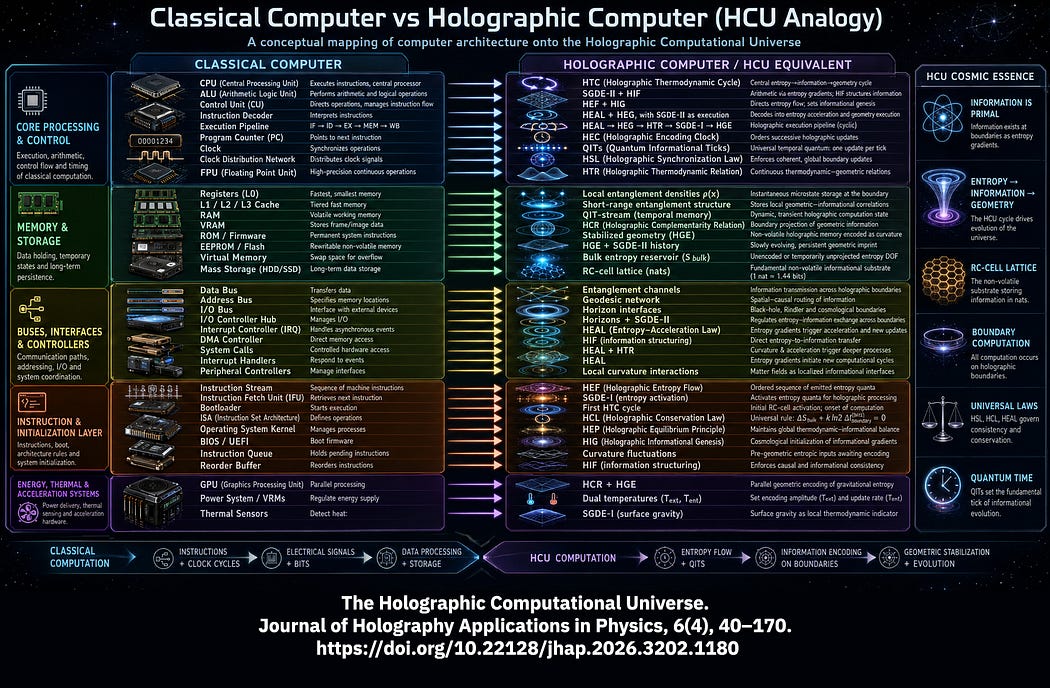
This illustration presents the analogy between a classical computer and the Holographic Computer (HC) proposed within the Holographic Computational Universe (HCU) framework. The goal is not to claim that the universe is literally a digital machine made of electronic components, but to use computer architecture as a conceptual language for explaining how HCU describes reality as a holographic, thermodynamic, and informational process.
In a classical computer, the Central Processing Unit (CPU) coordinates computation, the Arithmetic Logic Unit (ALU) performs logical operations, the Control Unit (CU) manages instruction flow, the clock synchronizes activity, memory stores temporary and permanent data, buses transfer information, and firmware initializes the system. The illustration maps each of these functions onto a corresponding holographic process in HCU.
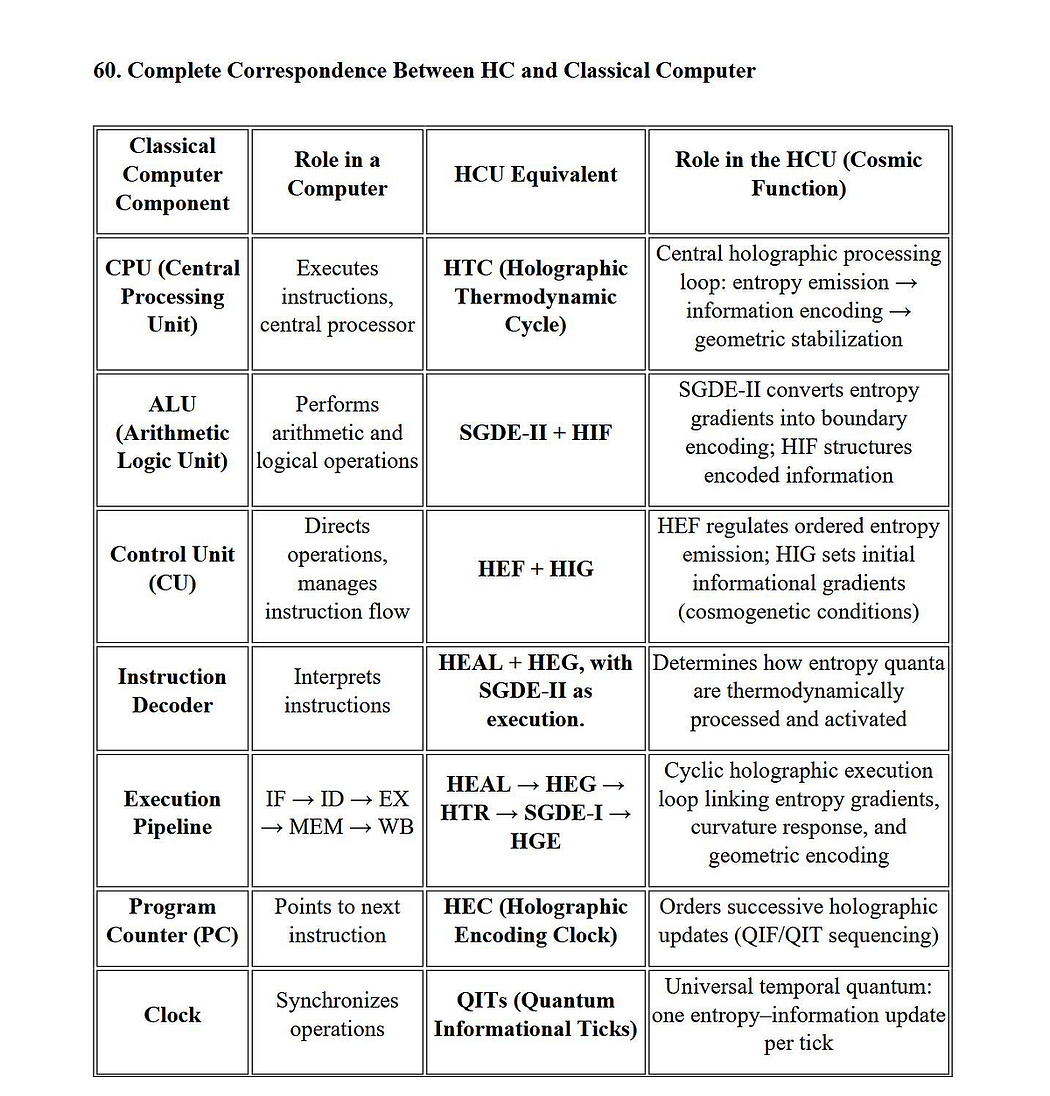
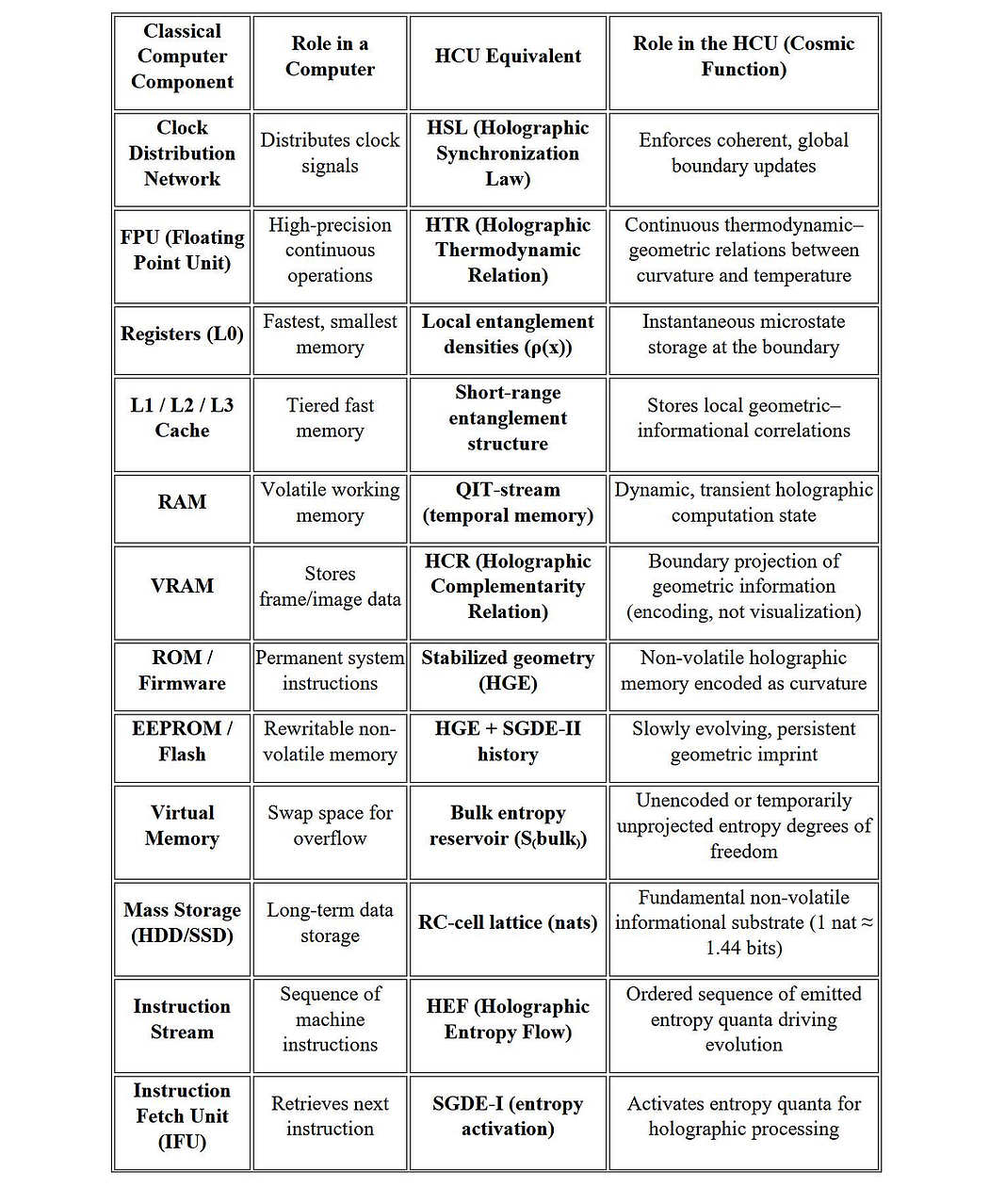
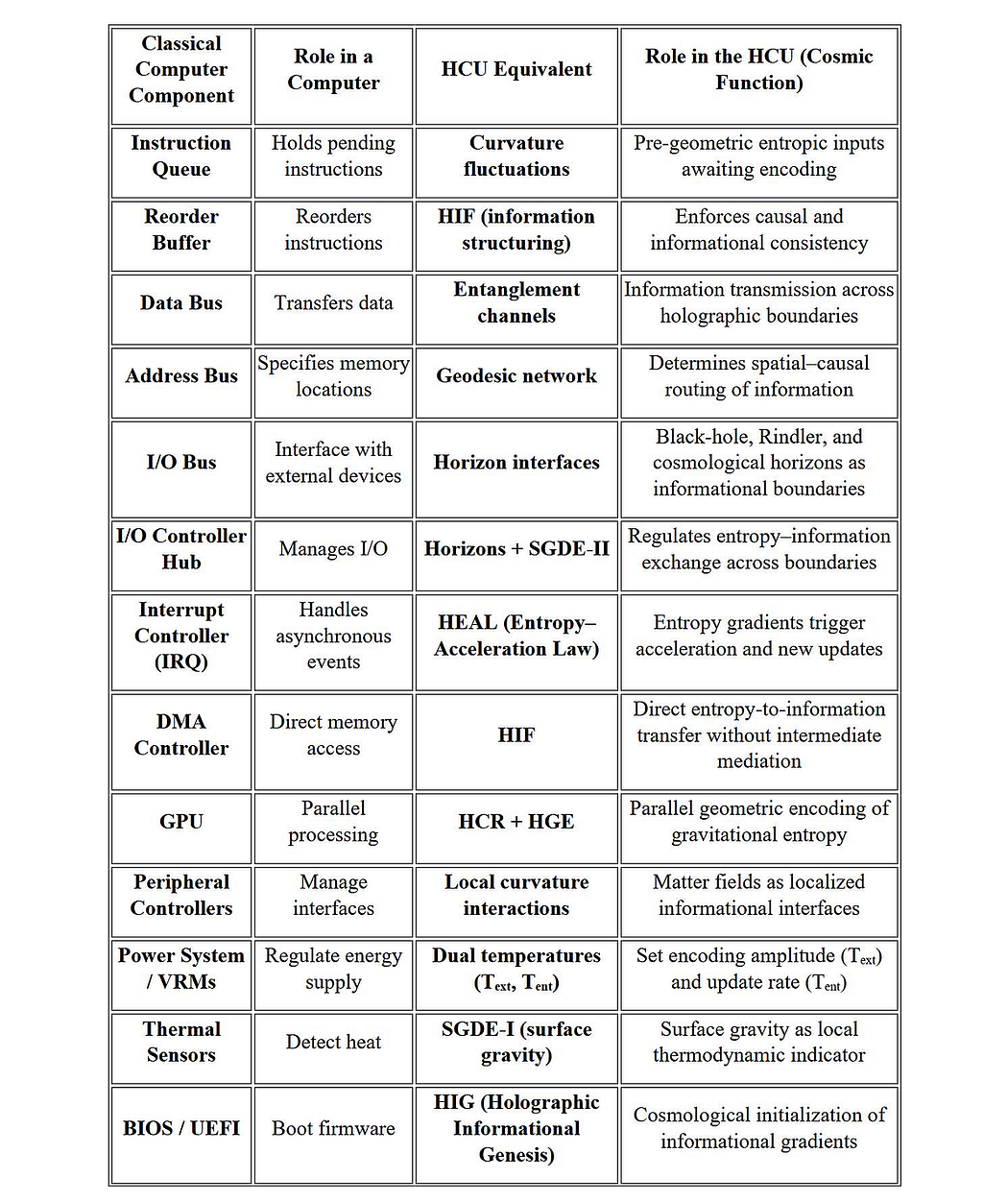
At the center of the HCU analogy, the CPU corresponds to the Holographic Thermodynamic Cycle (HTC). The HTC is the main processing loop of the Holographic Computer: bulk entropy is emitted, converted into boundary information, and stabilized as geometric structure. In this sense, the HTC plays the role of the cosmic processor, not by executing symbolic instructions, but by continuously transforming entropy into information and geometry.
The ALU corresponds to Surface Gravity Dynamic Entropy II (SGDE-II) together with Holographic Information Flow (HIF). SGDE-II represents the irreversible inscription of entropy into boundary records, while HIF organizes the encoded information. Together, they perform the holographic equivalent of “logical processing”: entropy gradients are converted into structured informational states.
The Control Unit corresponds to Holographic Entropy Flow (HEF) and Holographic Informational Genesis (HIG). HEF regulates the ordered emission of entropy, while HIG represents the initial emergence of informational gradients. These two concepts define how holographic computation begins and how its flow is directed.
The classical clock is mapped onto Quantum Informational Ticks (QITs). A QIT is the minimal temporal unit of holographic updating. The Holographic Encoding Clock (HEC) orders these QITs into a sequence, making time itself the succession of irreversible boundary-encoding events. The corresponding rate is the Quantum Informational Frequency (QIF), which expresses how rapidly holographic information updates occur.
The memory hierarchy of the classical computer is translated into the informational structure of spacetime. Registers and cache correspond to local and short-range entanglement structures. Random Access Memory (RAM) corresponds to the temporary QIT-stream of ongoing holographic computation. Read-Only Memory (ROM) and firmware correspond to stabilized geometry, represented by Holographic Gravitational Entropy (HGE). Long-term storage, such as Hard Disk Drives (HDDs) and Solid-State Drives (SSDs), corresponds to the Rindler–Compton cell lattice (RC-cell lattice), where each RC-cell encodes one natural unit of information, or one nat.
The communication structure of the computer is also reinterpreted. The data bus becomes the system of entanglement channels. The address bus becomes the geodesic network that routes information spatially and causally. Input/output interfaces, or I/O systems, correspond to horizon interfaces, including black-hole, Rindler, and cosmological horizons. In HCU, these horizons are not passive boundaries; they are active informational interfaces where entropy and information are exchanged.
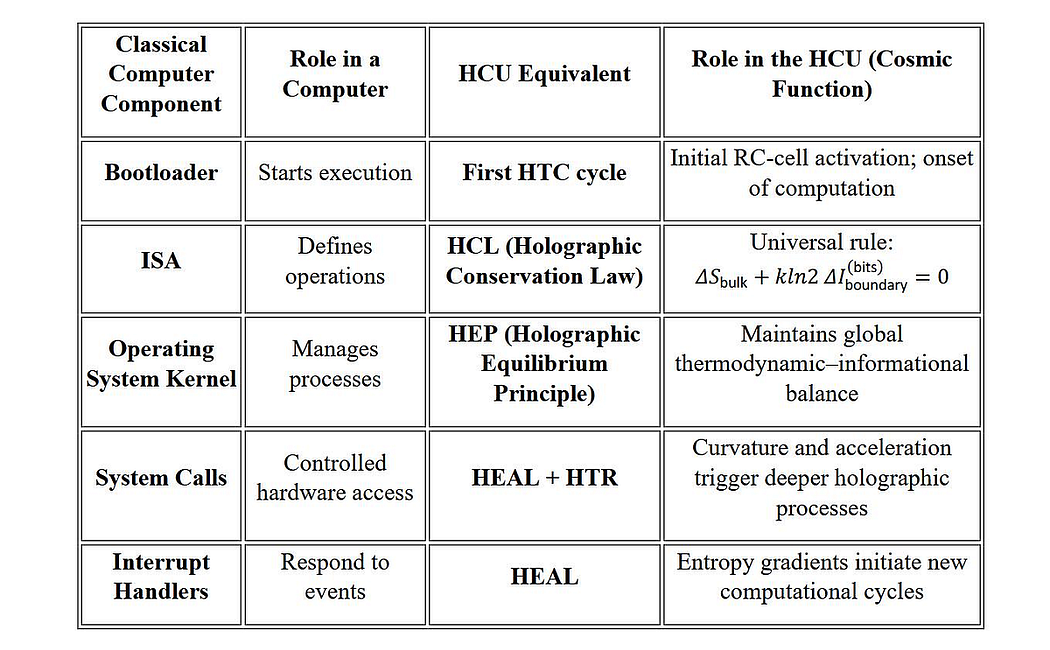
The Instruction Set Architecture (ISA) corresponds to the Holographic Conservation Law (HCL). In a computer, the ISA defines the allowed operations. In HCU, the HCL defines the universal rule governing entropy–information conservation:
This means that every decrease of bulk entropy is balanced by an equivalent increase of boundary information. The Operating System Kernel corresponds to the Holographic Equilibrium Principle (HEP), which maintains global thermodynamic–informational balance. The Basic Input/Output System (BIOS) and Unified Extensible Firmware Interface (UEFI) correspond to HIG, because they represent the initialization layer of the holographic process.
The illustration also includes thermodynamic and gravitational analogues. The Graphics Processing Unit (GPU) corresponds to the Holographic Complementarity Relation (HCR) and HGE, representing the parallel encoding of geometric information. The power system and Voltage Regulator Modules (VRMs) correspond to the dual-temperature structure of HCU, namely extrinsic temperature and entropic temperature. Thermal sensors correspond to Surface Gravity Dynamic Entropy I (SGDE-I), where surface gravity functions as a local thermodynamic indicator.
The essential result of the illustration is that the Holographic Computer is not a device located inside spacetime. It is a conceptual model for the process by which spacetime itself is generated, updated, and stabilized. A classical computer manipulates bits inside an already existing world. A quantum computer manipulates qubits inside spacetime. By contrast, the Holographic Computer operates at the level of entropy, information, curvature, and holographic boundary records. Its “processor” is the HTC, its “clock” is the HEC/QIT structure, its “memory” is the RC-cell lattice and stabilized geometry, its “communication network” is entanglement, and its “law of operation” is the HCL.
The diagram therefore summarizes one of the central claims of HCU: the universe does not run an algorithm in the ordinary computational sense. Instead, it computes itself through irreversible entropy-to-boundary-information transduction. Entropy emitted from the bulk becomes boundary information; boundary information stabilizes geometry; geometry preserves the history of prior updates; and the ordered accumulation of these updates gives rise to time, spacetime, gravity, and cosmic evolution.
Based on: