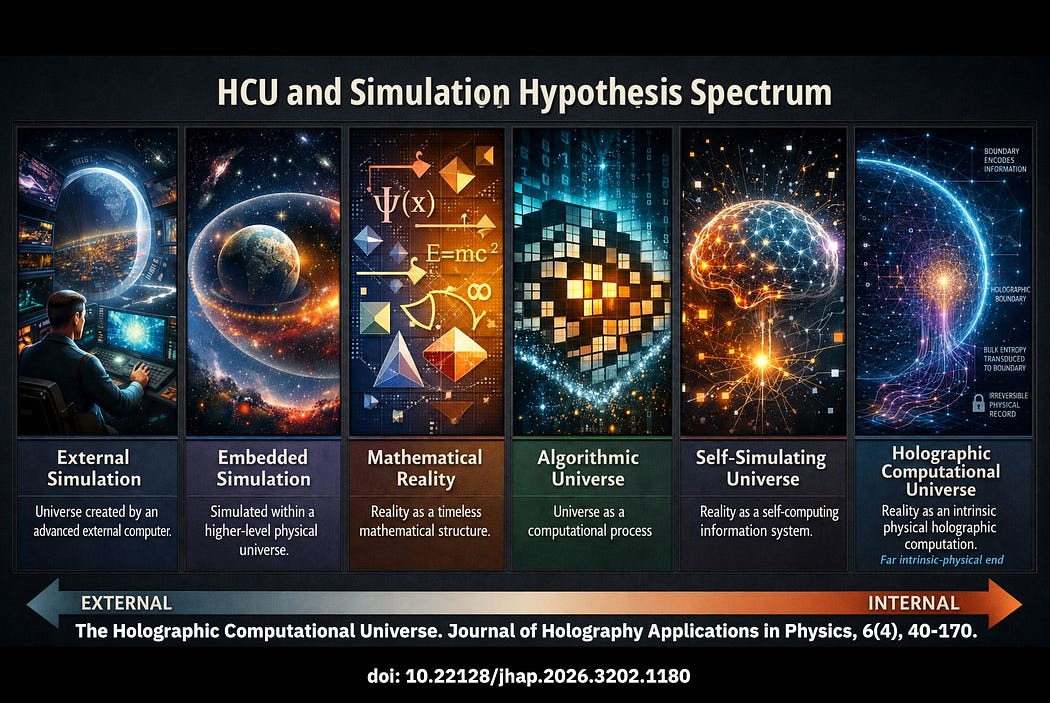
The Holographic Computational Universe: Toward a Thermodynamic-Informational Foundation

For decades, modern theoretical physics has pointed toward a striking convergence: information, entropy, geometry, and gravitation appear to be more deeply connected than classical formulations ever suggested. From Wheeler’s “It from Bit” to black-hole thermodynamics, holography, entanglement entropy, and emergent gravity programs, the question has progressively shifted from whether information is fundamental to how it becomes physical structure.
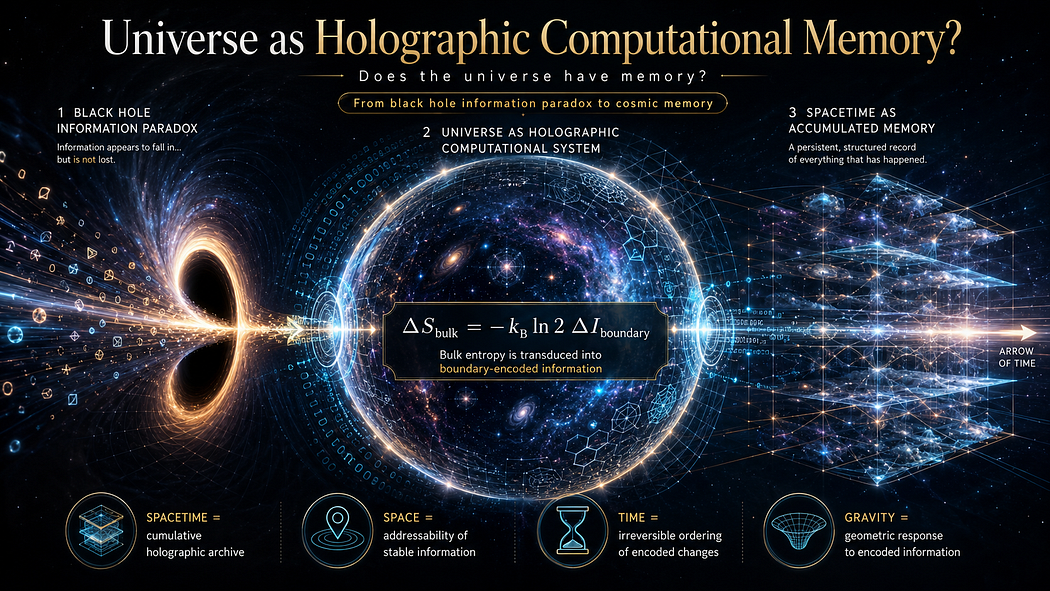
My recent framework, the Holographic Computational Universe (HCU), proposes a unified answer: time, spacetime, gravity, and matter emerge from the quantized and conserved transduction of bulk entropy into boundary information. In this view, the universe is not a pre-given geometric arena in which physical processes unfold. Rather, it is a continuously self-updating thermodynamic-informational system whose geometry is generated through irreversible holographic encoding.
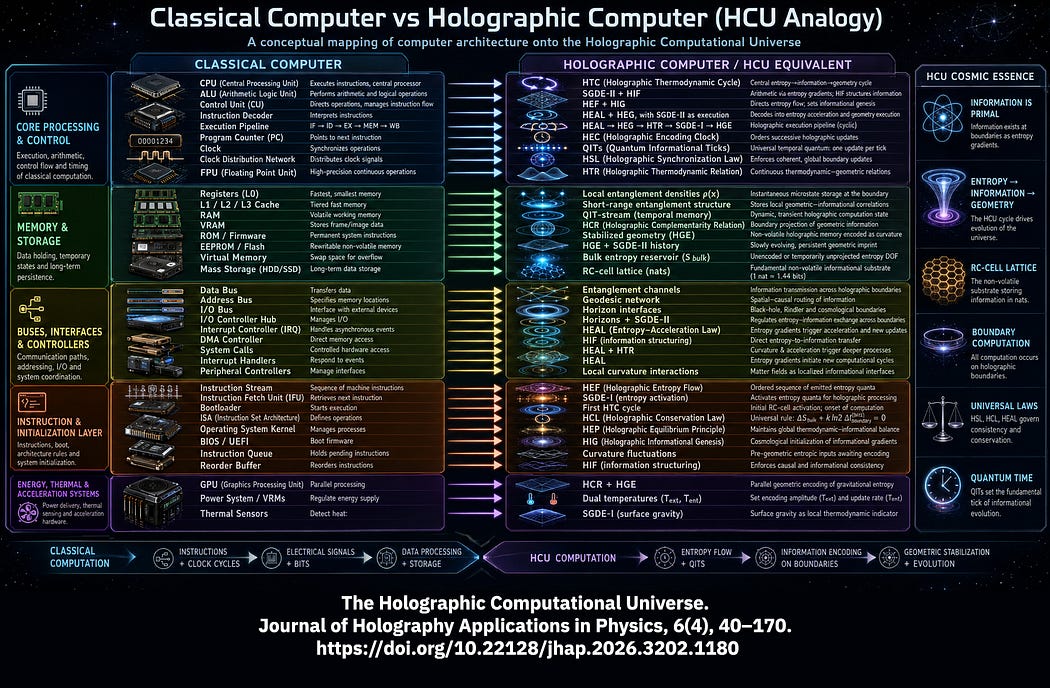
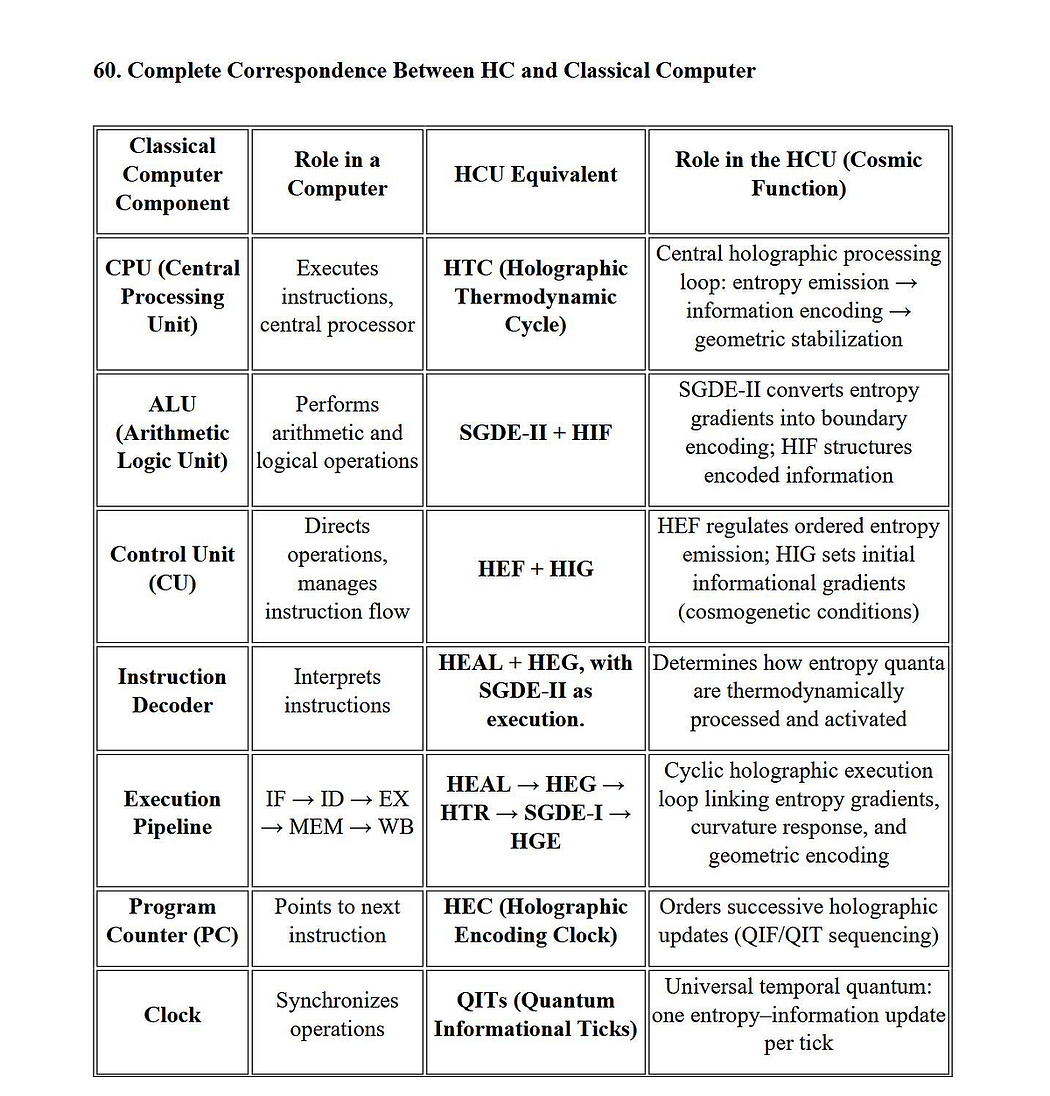
At the center of the framework is the Holographic Thermodynamic Cycle (HTC), an eight-phase renewal structure that governs the conversion of bulk entropy into boundary-encoded information while preserving global informational balance. This process is synchronized by the Holographic Encoding Clock (HEC), defined through the dual quantities Quantum Informational Frequency (QIF) and Quantum Informational Tick (QIT). In HCU, time is therefore not treated as an external background parameter; it is the ordered sequence of discrete informational updates through which reality renews its structure.
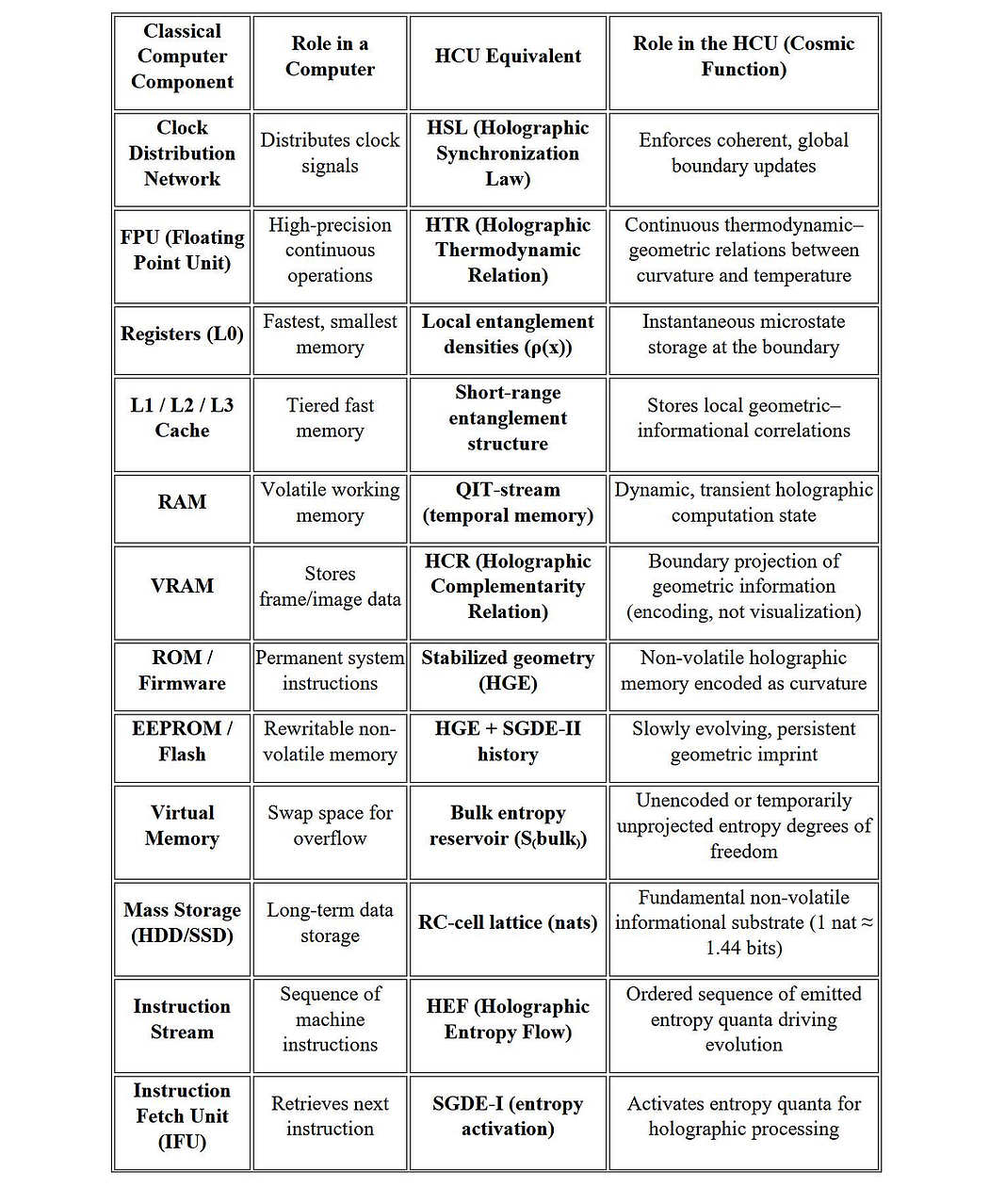
This leads to a second central proposal: spacetime is quantized into Rindler–Compton (RC) cells, each encoding one natural unit of information. The sequential activation of these RC cells defines a discrete microscopic architecture for spacetime and provides a dynamical basis for what I call Holographic Quantized Expansion. On this view, cosmic expansion is not fundamentally the stretching of an already existing manifold, but the progressive activation of new informational degrees of freedom.
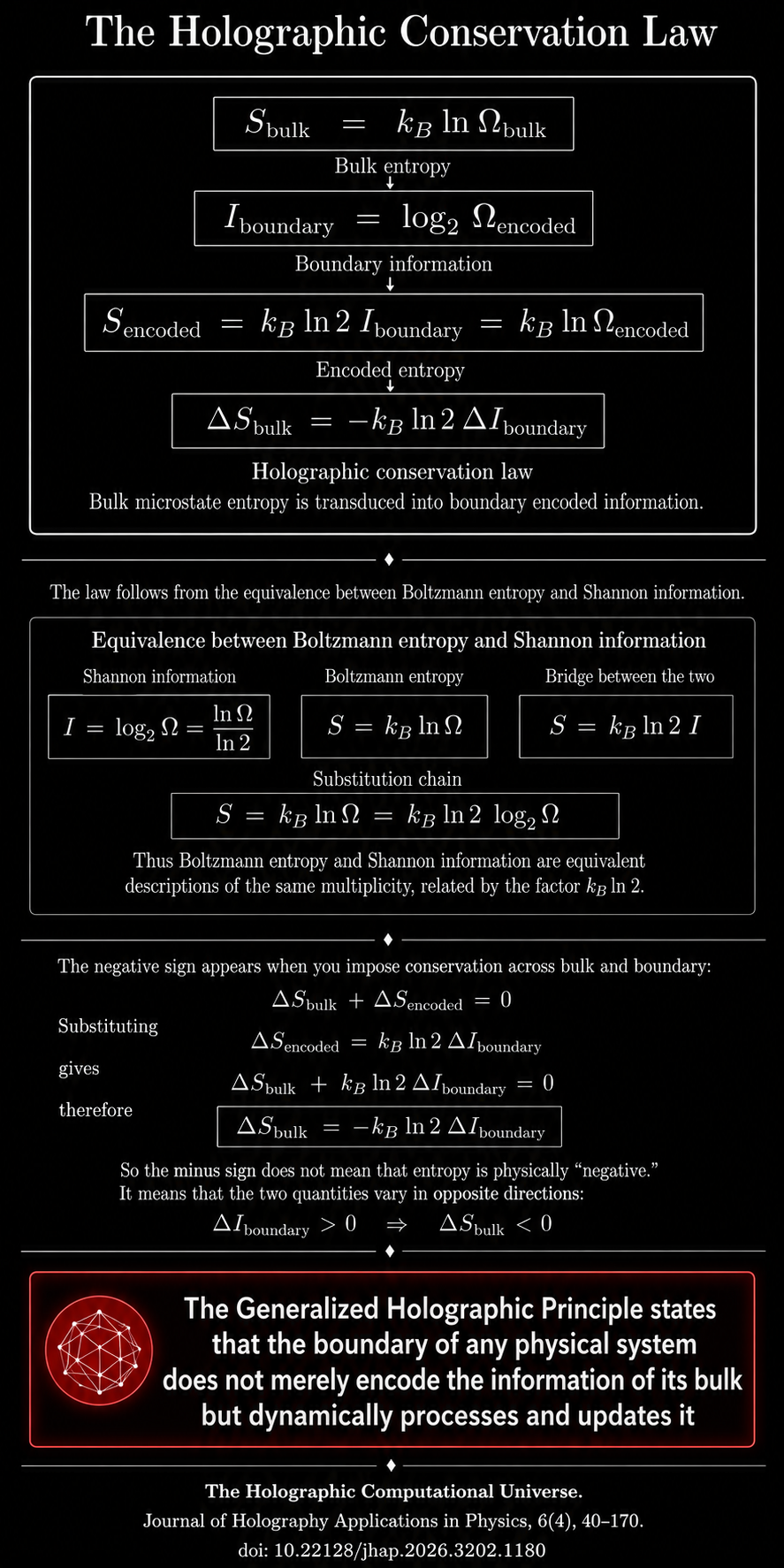
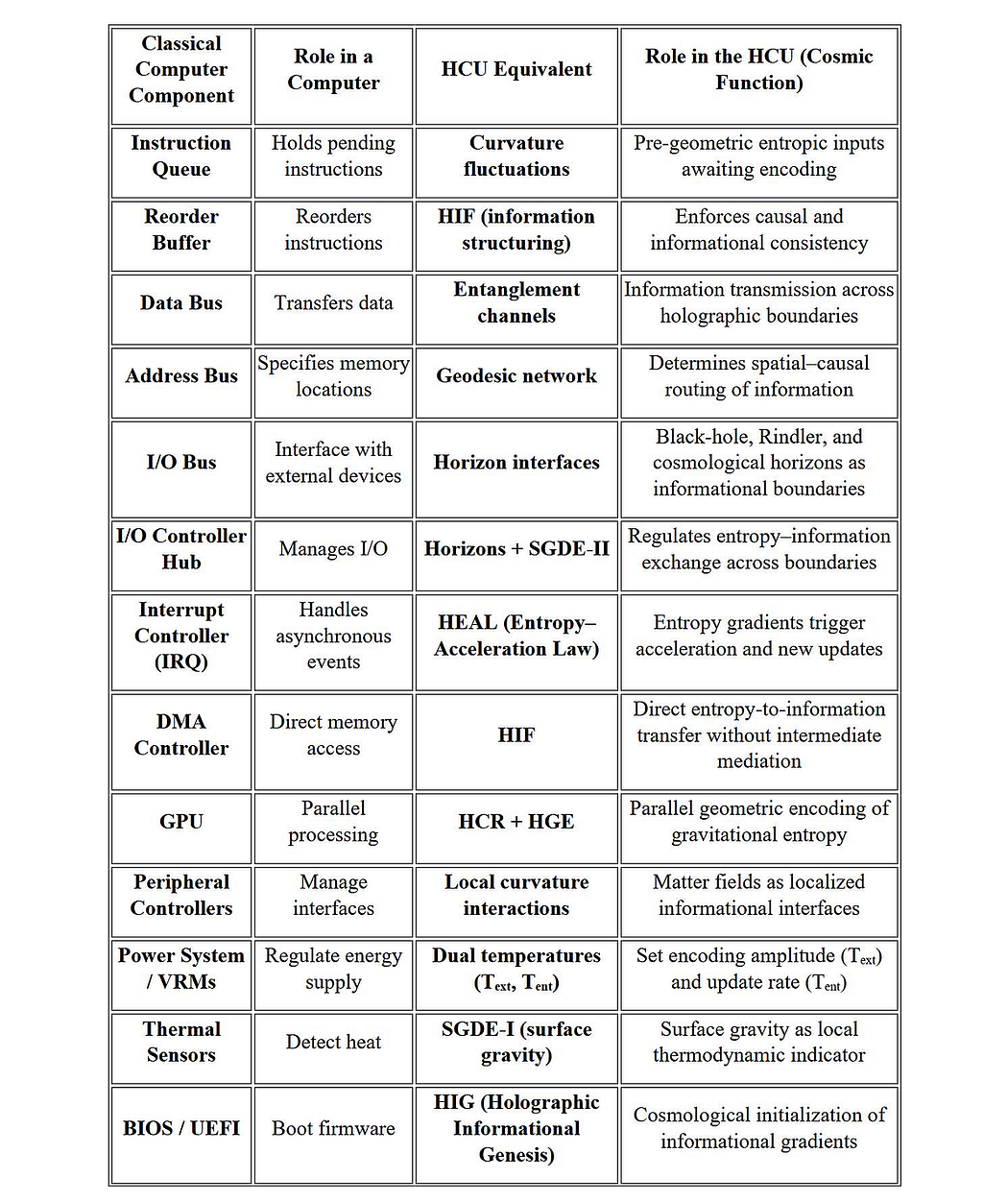
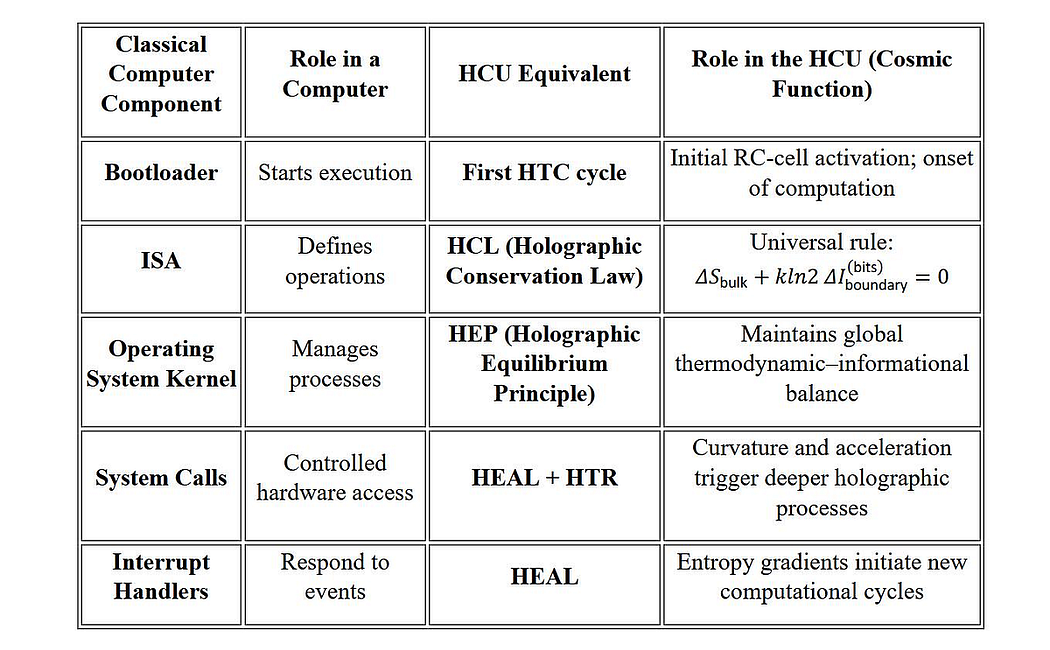
The framework also reformulates gravity. In HCU, gravity is not introduced as a primitive interaction. It appears as the thermodynamic response to informational disequilibrium, with curvature generated by entropy gradients across holographic boundaries. More generally, bulk entropy loss and boundary information gain are linked through a conserved holographic exchange structure: the loss of kln2k\ln 2kln2 of bulk entropy corresponds to the gain of one bit of boundary information. This turns holography from a static geometric statement into a dynamical conservation principle.
A further point of departure is methodological. HCU treats the universe as computational, but not in the ordinary algorithmic sense. It does not describe reality as a symbolic program running inside an external substrate. Instead, the framework argues that the universe “computes itself” physically, through irreversible entropy-information transduction. In that sense, computation is understood thermodynamically and ontologically, not merely formally. The proposal is therefore explicitly non-algorithmic: each informational update expands the accessible phase space and generates new physical structure that is not pre-enumerated in advance.
One of the aims of HCU is to provide a common dynamical architecture underlying several existing lines of thought in gravitational and informational physics. In the paper, the framework is positioned relative to Sakharov’s induced gravity, the holographic principle of ’t Hooft and Susskind, Jacobson’s thermodynamics of spacetime, Ryu–Takayanagi and quantum extremal surface programs, van Raamsdonk’s entanglement-geometry correspondence, Verlinde’s emergent gravity, and Vopson’s information-based approach. The claim is not that these programs are identical, but that many of them can be reinterpreted as equilibrium, semiclassical, or partial projections of a deeper entropy-information engine.
For a framework of this kind, conceptual scope is not enough. It must also expose itself to possible empirical failure. A central feature of HCU is therefore its emphasis on falsifiability. The paper advances concrete experimental directions, including a predicted entropy-rate ceiling and a rate-limited Landauer erasure regime, where deviations from standard Landauer behavior could appear in controlled systems. If such effects are not found where the framework says they should be, that matters. In my view, a serious foundational proposal must not only reinterpret existing theory; it must also risk being wrong.
What I am proposing, ultimately, is a shift in ontology. HCU suggests that spacetime is not the starting point of physics but one of its outputs; that time is not a passive parameter but a count of irreversible informational events; and that gravity is not merely geometry, but the macroscopic signature of thermodynamic-informational regulation. Within this framework, entropy does not merely describe physical systems; it helps generate their geometry, dynamics, and temporal order.
I am sharing this work here to invite discussion from researchers working across theoretical physics, holography, quantum gravity, thermodynamics, information theory, and foundations of spacetime. Constructive criticism is welcome. The central question is straightforward, even if the implications are not:
Could spacetime itself be the emergent record of irreversible holographic computation?
“The Holographic Computational Universe,” is now available online in the Journal of Holography Applications in Physics (Article in Press).